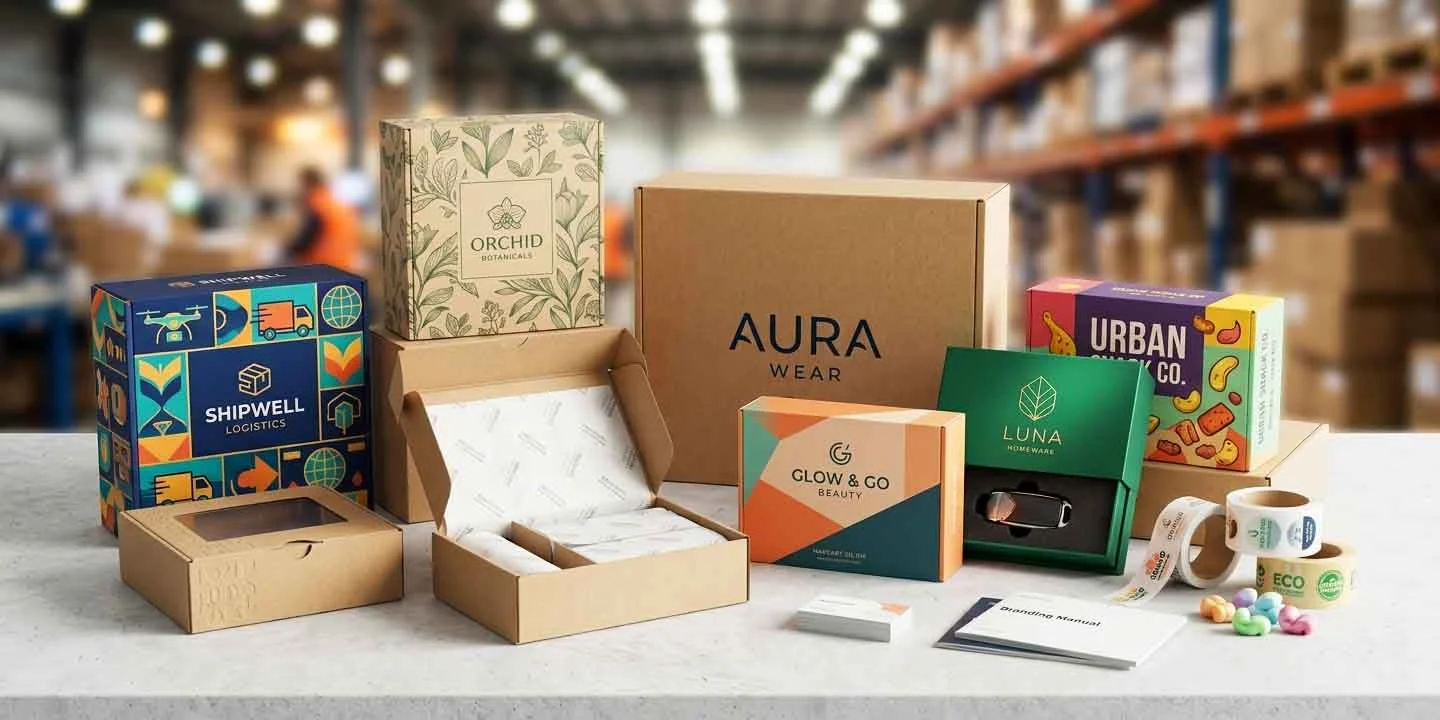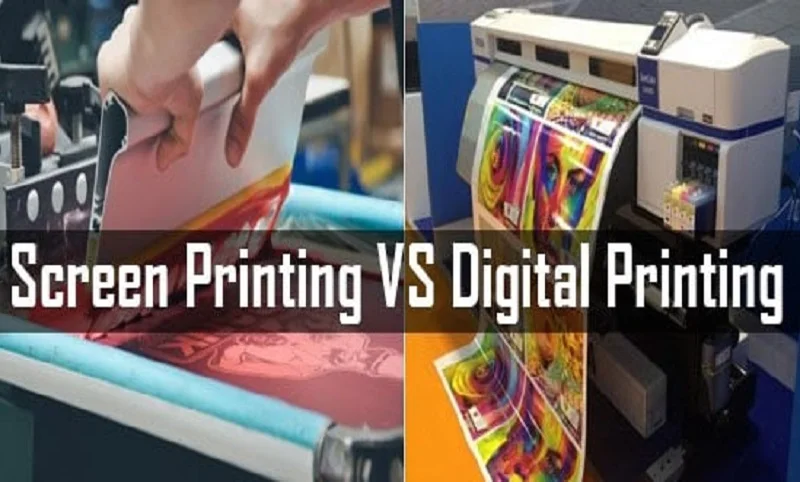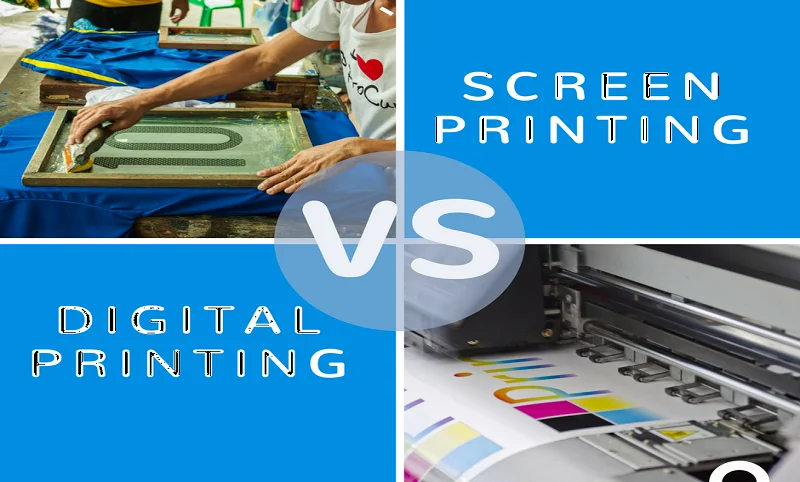
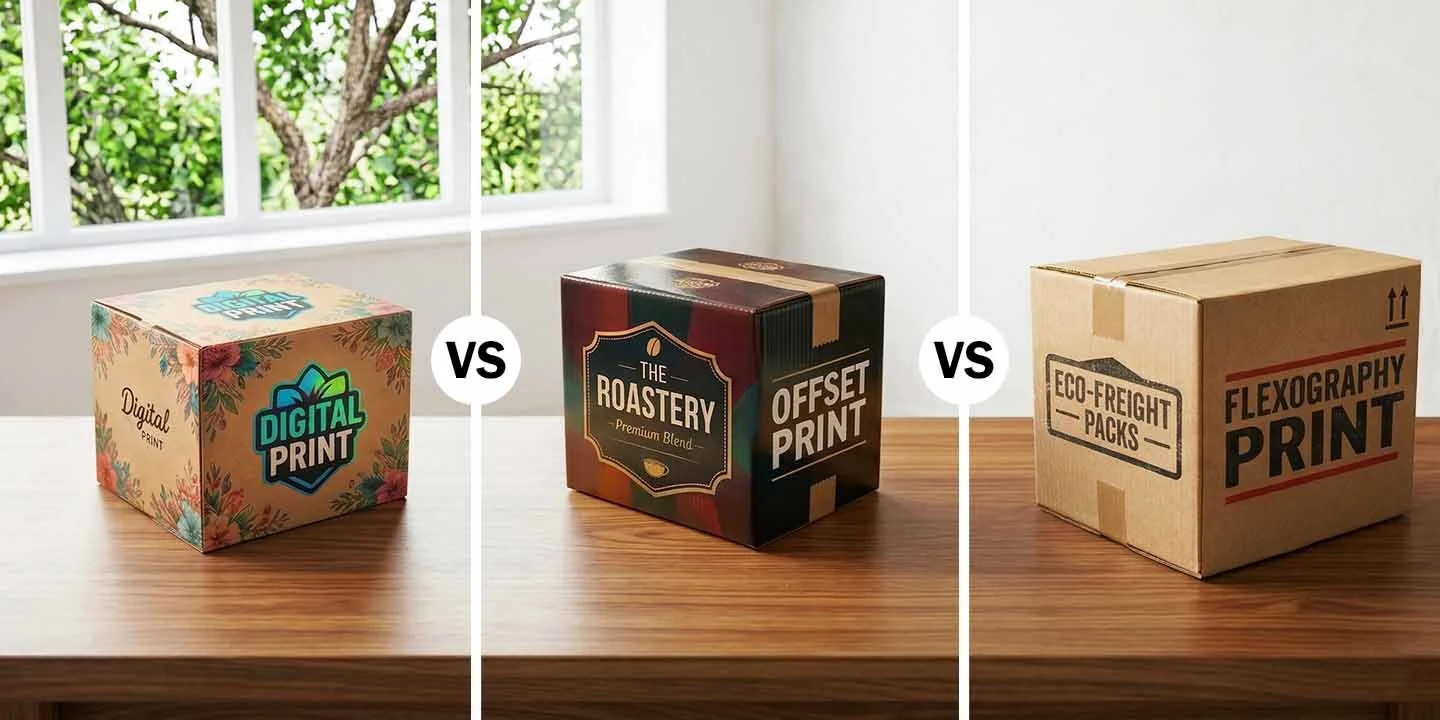
Like every business or brand, you also want your product packaging to outshine and outperform others. But do you know, besides high-quality material, what makes your packaging catch customers’ eyes? That’s the printing that can either impress customers or make your product ignored. Gone are the days when we didn't have the option to choose the printing techniques according to our budget. Thanks to the advancements in technology, now we have different box printing methods: digital printing, offset printing, and flexography.
In the current era, we can choose the type of printing that meets our printing requirements without disturbing your budget, volume, and quality. Now we can ensure the high print quality in packaging that influences customer decisions and enhances the brand experience.
In this guide, we are going to cover the core three box printing methods: digital vs offset vs flexography. This comparison will help you to choose the right printing method for your packaging to elevate the branding experience. We will cover a practical roadmap in detail on how each printing method works, its best uses, and other factors associated with it. By the end of this guide, you will be able to make the final and correct decision for your packaging. Let’s get started!
In the competitive era of custom packaging, printing is more than just putting the ink on the paper. It is the main character of the custom packaging that directly influences the visual appeal of the final product. It shapes customer perception about how durable and high-quality the product is and that it belongs to a reputable and credible brand.
The importance of printing in packaging can be understood by the following facts:
“In 2024, the global packaging printing market size was recorded at USD 417.8 billion. The market size is expected to grow at a CAGR of 6.8% from 2025 to 2030 to reach USD 615.7 billion by 2030.” [Credit: Grand View Research]
It is important to choose the right packaging printing method that aligns with your brand identity. By choosing the right method, we mean right in terms of cost and supply chain performance. Each printing technique is different from the others based on quality, substrate, compatibility, and unit economics. So you will have to choose the right printing method based on the order volume, visual requirements, and market positioning. The right printing method will spotlight your brand among thousands of products.
With the advancements in technology, printing techniques have come a long way. The most prevalent printing methods include digital, offset, and flexography techniques. If you want to elevate your packaging, you must know about the benefits and disadvantages so that you can choose the right packaging. Let’s discuss each type of printing:
Digital printing is the type of printing that does not require printing plates to transfer the image onto the substrate. It is like printing using the home printers that use electronic files to print on substrates. The inkjet and laser digital printers transfer the image on the substrate by applying inks or toners to the substrate. The substrates can be paper, cardboard, rigid, glass, or metal materials. These printers work only with CMYK and expanded gamut CMYKOGV to achieve the best printing results.

With the advancement in technology, businesses now prefer printing methods that give fast turnaround and cost them as little as possible. Therefore, the market size of digital printing is increasing, and its growth can be estimated by the following facts and figures:
“It is expected that the digital printing packaging market will be growing at a CAGR of 5.1% from USD 20.6 billion in 2025 to USD 33.8 billion by 2035.” [Credit: Future Market Insights]
The digital printers do not require setup for printing. The image or artwork to be printed is designed on the computer and is directly printed on the substrate. It uses inks or toners for printing. It facilitates you with variable data printing, such as varying logos, designs, colors, and information, without having to switch out different anilox rolls.
Digital printing is supported for various substrates and materials on which you can print. The substrates include paper, cardstock, rigid materials like wood or glass, vinyl, and other materials.
Digital printing is a cost-effective printing method, especially for short-run and on-demand jobs. It offers the following applications in the custom box printing:
For Production Of Exact Number Of Volume: There is no minimum order requirement for digital printing. With this printing method, you can print the exact number of prints you want.
High Resolution Graphics: This printing method provides high printing quality for the intricate designs and photo-quality images.
Variable Data Printing: This type of printing method lets you print different types of data formats, including barcodes, QR codes, text, etc.
Integration With Augmented Reality: Digital printing can be integrated with Augmented Reality (AR) for creating interactive and engaging packaging.
| Digital Printing: Pros & Cons Comparison | |
|---|---|
| Pros of Digital Printing |
Cons of Digital Printing |
| Reduced Ink Waste: As it does not rely on the printing plates, the ink waste is reduced. Moreover, it is compatible with eco-friendly inks, so the environment is safe. | Limited Color Palette: The digital printing does not support exact matching with PMS color schemes. |
| Budget-Friendly Printing Method With Fast Turnaround: This is a cost-effective method because it does not need any kind of printing plates or screens, so there is no setup cost. It has a fast turnaround time for short runs and on-demand printing jobs. | Less Cost-Effective For Large Volumes: The digital printing will not be cost-effective if you want it for large volumes, as inks and toners are expensive. The digital inks with higher unit per cost for large volumes will make printing more expensive. |
| Versatile Compatibility With Substrates: This printing method is versatile to be used with different printing surfaces. You can print on all types of surfaces, including paperboard substrates or rigid substrates (glass and metal). | Not Vibrant For Non-White Substrates: The digital printing might not turn out vibrant for non-white substrates, especially the Kraft paper that has a naturally brown color. You will need to coat the non-white surfaces with white paint. |
| Instant Drying: The inks, after curing, dry instantly, which reduces the processing time and assists immediate finishing. | Limited Coating and Durability Options: As compared to other printing methods, you have limited coating choices. |
Digital printing is considered best for fast prototyping, variable data, short runs, and seasonal or regional packaging. It is highly recommended for industries, including food, beauty, supplements, and e-commerce, that need variable data such as QR codes and serialization.
When your concern is exact PMS matching, luxury finishing, and large volume production, digital printing is not recommended.
Offset printing, also known as lithography, is an old and traditional printing technique that has been used for custom packaging for years. This type of printing provides excellent output. It is designed to operate on the principle of oil repelling water. This technique involves a three-step printing process. This process involves transferring the ink from an aluminum-engraved plate to the rubber blanket, and the rubber blanket transfers the ink onto the substrate.
The offset printing uses a CMYK color scheme and works with some optional finishes like gloss, matte, soft-touch, UV, and aqueous finishes.
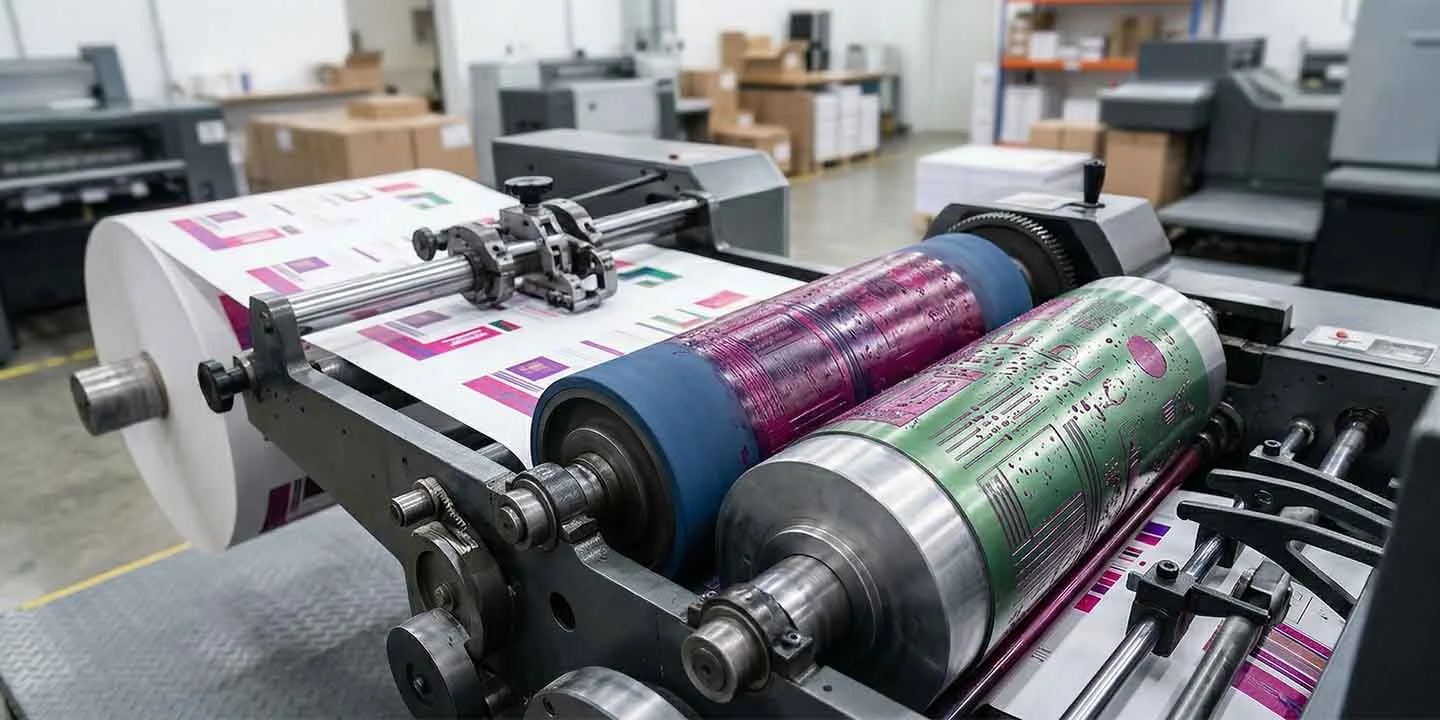
Offset printing is the oldest printing technique, which is still used today for its budget-friendly pricing for medium to large volume orders. In fact, its usage is increasing where color accuracy is important. Its market size can be estimated as follows:
The global market of offset printing was estimated in 2024 at USD 3 billion. It is projected to grow at a CAGR of 14.1% in the forecast period 2024 to 2030, and it will reach USD 6.6 billion by the year 2030. [Credit: Research And Markets]
Offset printing works in three steps: It transfers the ink from an aluminum-engraved plate to the rubber blanket first, and then transfers the ink from the rubber blanket to the substrate. Moreover, it is designed on the principle that oil and water repel each other. Let’s understand the working in detail:
Plate Creation: In the first step, the metal plates are prepared with the desired image or text. The plates are treated to make sure that the ink adheres to the image areas only.
Ink and Water Application: The plates are damped with water, keeping the principle in mind that water will repel the oil-based inks. This is done to ensure that when ink is applied to the plates, it adheres only to the image areas.
Transfer To Rubber Blanket: In this step, the inked image from the metal plate is transferred to the rubber blanket, which offers a smoother and better surface for printing.
Printing On Substrate: Finally, the image is transferred to the substrate.
Offset printing is compatible with numerous materials, including paper, metal, cardboard, cellophane, and vinyl. For printing, the printing surface must be smooth and flat. It can be used for printing magazines, newspapers, books, stationery, posters, brochures, and other items.
Offset printing is one of the old methods used for high-quality printing. For packaging, it offers many uses, some of which are given below:
Medium To High Volume Orders: For medium- to high volume orders, this printing technique is the budget-friendly printing method as compared to digital printing.
High-End Consumer Packaging: Offset printing is used for the packaging of high-end products that generate vibrant and color-consistent results.
Retail Display Packaging: The retail displays contain attractive visuals that attract customer attention instantly. For retail display packaging, offset printing is mostly used to create attractive and vibrant visuals.
Books and Magazines: For printing detailed images and text on various paper types, lithography is used.
Brochures: It produces high-quality output for marketing materials like brochures and flyers that capture attention.
Stationery: Lithography is used for professional documents, including professional letterheads, envelopes, and business cards.
| Offset Printing: Pros & Cons Comparison | |
|---|---|
| Pros of Offset Printing |
Cons of Offset Printing |
| Excellent Print Quality: Lithography offers you excellent print quality for fine details, intricate designs, and clean text. | Higher Initial Costs: For small and limited runs or SKU proliferation, it is expensive because of the higher setup cost. |
| Rich Branding Appeal: This printing adds a premium look and feel to make your packaging attractive. | Longer Production Time: It is not a quick setup type of printing, so it will take longer production and turnaround time. |
| Wide Color Gamut: Due to the wide color gamut, this method can create a range of colors that is required for complex designs and branding requirements. | Limited Compatibility With Substrates: Offset printing is designed to be used with flat surfaces, so it might not be compatible with cardboard substrates. |
| Consistent Results: This type of printing produces consistent output in different print runs that maintains the brand integrity. | Ink On Corners Is Prone To Cracking: When the substrates are folded or cut, this may crack the ink on the corners. |
This printing technique is highly recommended for color critical applications where exact color matching is paramount. Use offset printing for printing rigid box wraps, cartons, and premium retail packaging.
Offset printing is not recommended if you want to print variable data formats and want short-run jobs and flexible materials.
The offset printing is highly recommended if you want high-quality, detailed images and text on paper-based substrates. It is good for large print runs where setup costs are spread out.
Flexography, also termed "Flexo," is a type of printing technique used for flexible printing surfaces. This technique is one of the most commonly used techniques to print visually appealing colors. It is recommended for large job runs that include printing of hundreds to thousands of labels with attractive color labels.
The roots of the basic flexography process date back to the 19th century. At that time, flexography was not as refined and versatile as we experience today. In the past few decades, flexography has been upgraded to be more beneficial for businesses. It is improved with the integration of direct laser engraving technology, advancements in image carrier materials, and in-press technologies. Now, this printing technique is growing and used for industries including schools, homes, medical, pharmaceutical, and other industries.

In addition to the digital and offset printing techniques, flexography has also become one of the popular printing techniques. It is chosen by many businesses for the fast turnaround time, compatibility with flexible surfaces, and economical pricing for large volumes.
“In the year 2024, the flexography market was worth $230 billion at constant prices. The market size for flexography is estimated to grow at a CAGR of 3.0% from the year 2024 to 2029.” [Credit: Smithers]
The flexo printing uses elastomer or polymer image carriers, including sleeves, cylinders, and plates. The image carriers are engraved with the text or image to be printed. This printing process involves flexible rubber or photopolymer printing plates that are mounted on the cylinders. From cylinders, the ink is transferred onto the substrate. Let’s learn step-by-step how flexo printing works:
Plate Creation: The first step in flexography is the preparation of the flexible plates. The flexible plates are first engraved with the text or image you want to print on the substrate.
Ink Application: After the preparation of the plates, the annolox roller is used to apple inks to the raised surfaces of the plate.
Printing: After the ink application, the plate is then pressed onto the substrate to produce the print.
Drying: The last step is to wait for the ink to dry. This is done by passing it through a drying system, which ensures high-speed production.
Flexography is used for both types of substrates: absorbent or non-absorbent. This will work well with different flexible packaging and box materials, like cellophane, foil, plastic, metal, cardboard, sweet wrappers, kraft, BOPP, PE, PET, and fabric. Flexography can be used with any flexible surface. This type of printing can be used for packaging, envelopes, retail bags, label stock, newspapers, and wallpaper.
Flexography is a commonly used choice because of its speed, versatility, and printing compatibility with multiple substrates. Its common applications include the following:
Labels and Tags For Food Packaging: In food and beverage packaging, custom-printed labels and tags are used to label the food and the brand. For printing labels and tags, flexography is used.
Corrugated Packaging and Cartons: Flexography is used for printing on packaging designed with corrugated materials, including the folding cartons, regular slotted containers (RSC), and corrugated boxes.
Newspapers and Magazines: This printing is suitable for various types of papers, including newspapers and magazines with a porous surface.
Shipping Boxes: To print logos and simple typography on shipping boxes, this printing technique is used.
Retail Packaging With Moderate Design Complexity: This technique is also used for retail packaging that needs moderate design complexity.
| Flexography Printing: Pros & Cons Comparison | |
|---|---|
| Pros of Flexography |
Cons of Flexography |
| Versatile Compatibility: Flexo printing is compatible with most of the substrates, including plastic foil and paper. | Inability To Accommodate Variable Data: Flexo printing involves preparing plates ahead of time to print a single image only. It does not support variable data printing. |
| Fast Speed and Quick Turnaround: It is a fast process, which makes it ideal for large production runs. The setup time is short, which leads to faster production and delivery of custom boxes. | Limited Color Reproduction: Besides its ability to produce good color results, it can't match the color accuracy and consistency of digital and offset printing. |
| Budget-Friendly: If you have to print a low-volume order, this printing technique is a cost-effective option for you. | Unable To Accommodate Fine Details: This technique is not suitable for printing intricate and fine details. It is less effective in doing so than other high-resolution techniques. |
| Water-Based Inks: To reduce the environmental impact, flexography can be used with water-based inks. | Expensive and Longer Setup for Short Runs: This process will involve a relatively longer setup for printing small quantities, so it will be costly for short-run jobs. |
When you want printing for corrugated boxes, high-volume programs, and flexible packaging, flexography is recommended. It is ideal for self-adhesive, food packaging, and plastic bag labels.
If you want intricate and detailed graphics and high-resolution printing, we do not recommend flexography printing.
Pro Tip: “With flexography, if you want to reduce the production cost and changeover time, minimize the number of spot colors you are using. This will eliminate the need for a separate plate setup for each color”.
| Packaging Printing Methods Comparison | |||
|---|---|---|---|
| Factors | Digital Printing |
Offset Printing |
Flexography Printing |
| Suitable for Materials | Paper, cardstock, rigid materials like wood or glass, vinyl, and other materials | Paper, metal, cardboard, cellophane, and vinyl | Sweetwrappers, Kraft, BOPP, PE, PET |
| Print Quality | Offers better and sharper print quality in terms of consistent results | Offers high-quality printing for variable data | High resolution quality for images |
| Color Accuracy | Digital printing lacks exact color matching to spot colors | Highest color accuracy | Good for solid and bold colors, but can't exactly match the fine detail |
| Sustainability | Sustainable printing techniques for short runs, because they eliminate waste. | Less sustainable than the digital and flexo | The most sustainable printing technique that works with water-based inks |
| Cost Per Unit | High cost per unit for large volumes | Low cost for high volume orders per unit, but initially the setup costs are higher. | Very low for high volumes |
| Turnaround Time | Fast turnaround | Long turnaround time | Quick production and turnaround time |
As discussed at the start of the guide, different substrates behave differently with different printing techniques. Commonly used materials or substrates are SBS paperboard (18 to 24 pt), CCNB, and corrugated fiberboard (E flute and B/C flute).
Each printing material absorbs inks and coatings differently, so your material must match the printing technique.
Digital Printing: If you want a material or substrate for digital printing, primed or treated paper will work best with it.
Offset Printing: This printing technique works best with flat surfaces, whether they are coated or uncoated boards.
Flexo Printing: This technique works great with the corrugated boxes, but to avoid inconsistent printing quality due to the wavy structure, use the right line.
Choose finishes or coatings that match your brand style and look good on the packaging material. Not every finish is designed to look good on every material. Choose finishes that enhance the printing elements while preventing the elements from getting scratched.
Humidity in different regions can influence the substrate selection. For wetter regions, moisture in the air will affect how paperboard works with the printing. Due to high moisture, the printing on high-quality sheets will even be negatively impacted.
Choose a finish and coating that enhances the strength of the material and prevents printing from getting damaged.
The current era is the era of eco-consciousness, so every consumer and business is shifting towards practices that reduce pollution. Choose a printing technique that is sustainable and produces as little waste as possible.
Flexography is the most sustainable printing technique, as it works with water-based inks. Digital printing produces less waste, so it is also sustainable. While the offset printing is less sustainable in comparison to the other two printing methods.
Whether you choose any printing process, there are process parameters that are highly critical and cannot be negotiated. Let’s see the process parameters for each printing method:
For digital printing, the inkjet printers are used. These printers depend on the toner systems that fuse temperature and transfer calibration. These printers are focused on the drop placement and media profiling.

Another thing that lets you choose digital printing or not is the changeover time. The digital printing shifts artwork in 5 to 15 minutes, which makes it the fastest printing method compared to other printing techniques.
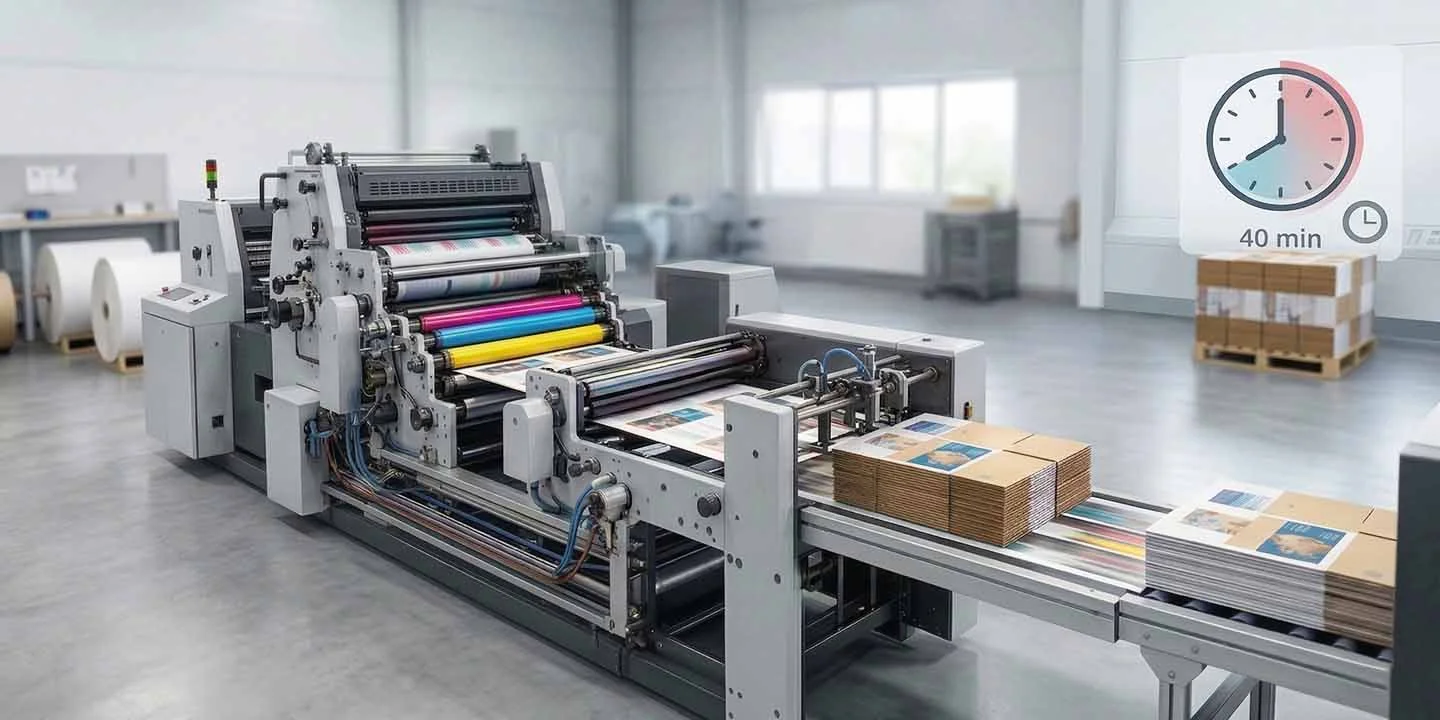
For offset printing, printers rely on the stable ink-water balance, consistent fountain solution, and clean blankets. The changeover time for offset printing is 20-40 minutes for plates and color stabilization.
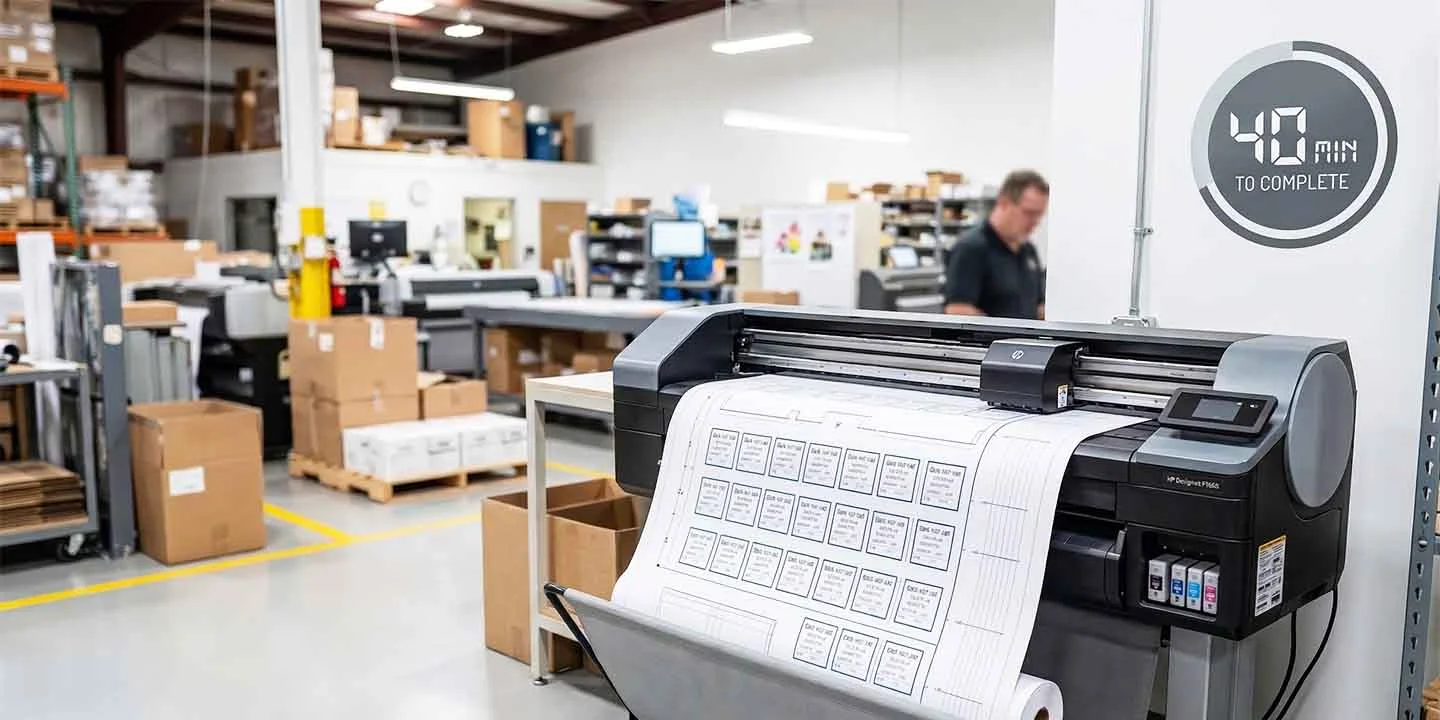
Flexography depends on different factors to produce high-quality results and quick turnaround. The factors include anilox selection, plate durometer, and impression. Flexo requires 40 to 90 minutes, which involves sleeve or plate swaps and registration work.
Colors are the first thing in printing that grabs the customer’s attention. Specifically in the brand logos, color consistency plays a significant role. The color accuracy is measured by a factor of △E. The design teams must target △E of roughly 2 to 3 if they want exact match colors. For example, for key brand colors. Because this helps them to match the exact colors. The supporting colors can be produced within the △E range of 3 to 5.
When colors are properly set up, you get consistent results with the digital printing.
We know that offset printing needs monitoring during long runs, but how can you overlook its exceptional results? It gives very beautiful and smooth colors that catch the eye. Offset printing offers better color consistency and accuracy in contrast to digital printing and flexography.
When plates and anilox are perfectly dialed, this printing method becomes suitable for stable spot colors.
It is recommended to always note down the acceptable tolerance range for colors and how the color will be measured. Don’t forget the device for measurement. Also, note down the number of checks to avoid any kind of confusion.
FPY% is the measure of how often a job prints perfectly for the first time without the need for any reprints. A good FPY% is 85 to 95% on repeated products.
To judge the color quality, don’t rely on the packaging photos you find online. Because they don’t guide you about the △E, lightning effects, production reports, and print calibrations. To judge the color consistency, you can ask for the following:
1. A press report
2. Color bar rating
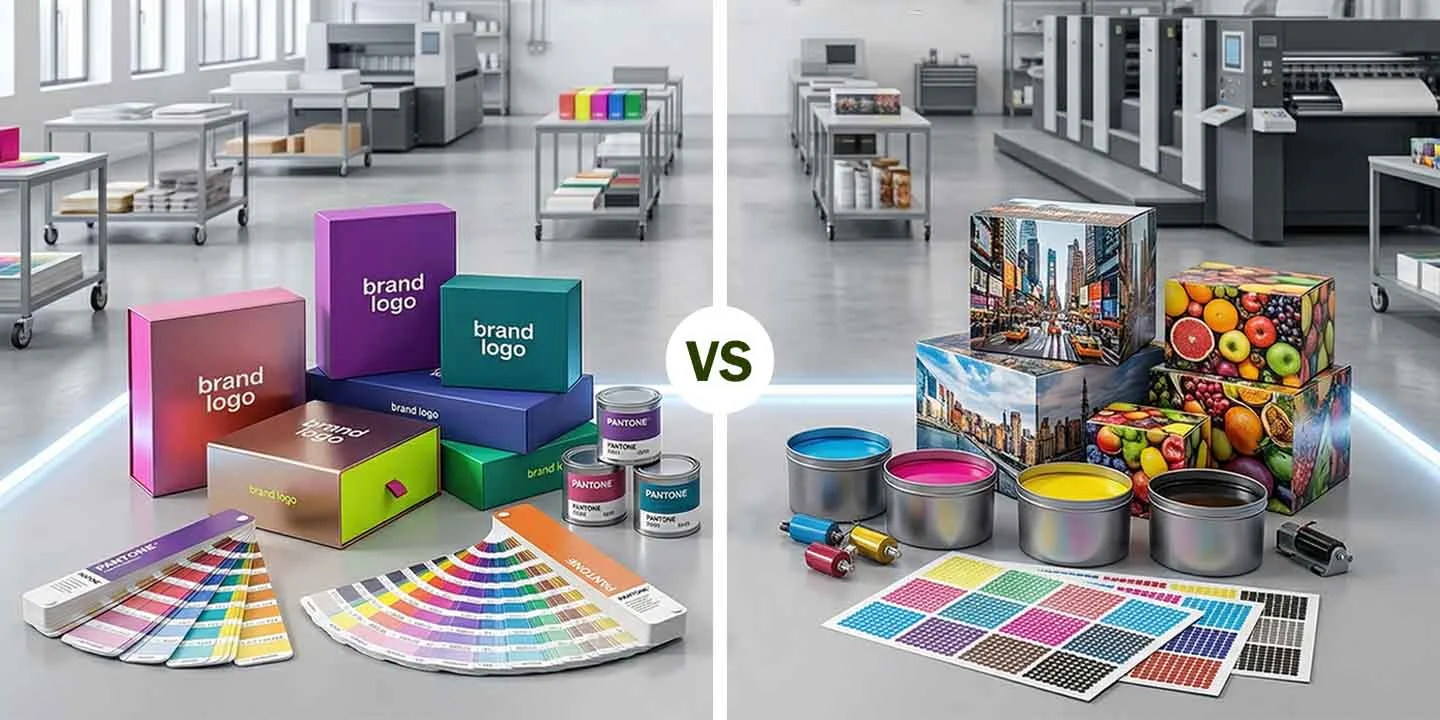
PMS and CMYK are the two popular color schemes used for printing. But which one is suitable for offset, digital, and flexography? Let’s compare each color scheme to find out:
PMS and CMYK are both the most prevalent inks used for printing, but what is the best depends on specific needs. The following table compares the PMS and CMYK color schemes or inks in terms of certain factors:
| PMS vs CMYK Color Systems Comparison | ||
|---|---|---|
| Factors | PMS (Pantone Matching System) |
CMYK (Cyan, Magenta, Yellow, Black) |
| What is it? | PMS stands for Pantone Matching System, which uses pre-mixed "spot inks" to produce colors that exactly match your brand logo. | CMYK refers to four colors: cyan, magenta, yellow, and black, the primary colors from which other colors are formed. |
| Color Accuracy and Consistency | It uses a pre-mixed ink designed on a formula so an exact color match can be achieved. | It mixes halftones or dot patterns of four colors, so slight variations can be achieved, but the exact color cannot be. |
| Range of Colors | PMS offers an extensive range of colors that includes solid colors, metallics, and even neons. | It also offers a wide range of color variations, but fewer than the PMS color scheme. |
| Cost | PMS is more expensive than CMYK. | CMYK is cost-effective. |
| Best Use Cases | Used especially in brand logos, colors, and high-impact branding where color consistency matters a lot. | It is best for full-color, high-quality photographic printing, such as in magazines, brochures, and books. |
Pro Tip: “If you are designing packaging with your logo, we suggest you choose a PMS color scheme to achieve an exact match of the colors your brand logo has. At the same time, choose CMYK printing for other elements of packaging. This hybrid approach will provide you with color accuracy for your brand while saving you cost”.
Certification and compliance, no doubt, feel less glamorous than the foiling, but it is mandatory if you want your products to stay on the retail shelves. So, different certifications are used for printing methods. Some regulatory compliance and certifications that must be mentioned on your packaging are listed below:

| Printing Certifications & Standards | |
|---|---|
| Category | Certification / Standard |
| Color and process | G7 and ISO 12647 |
| Responsible Sourcing | FSC or PEFC labeling pairs |
| Food and Beverages: Low migration ink, good manufacturing practice | EU 2023/2006 |
| Food Contact Materials | FDA 21 CFR 175/176 |
| Serialization and Code Addition | GS1 |
| QR and DataMatrix Readability | ISO/IEC 18004 |
Pro Tip: “We, as packaging partners, recommend that you always demand certificates, audit dates, and a sample of traceability records. It does not matter what type of printing you choose. Do not just rely on the reviews you found online because the compliance is documented with proof, not crowdsourced”.
The colors, design, and printed artwork are the first things on your packaging that attract customers. That’s why brands pay great attention to high-quality printing. The custom packaging gives you the chance to select the type of printing you want for your product packaging. But not every type of printing is suitable for every packaging material.
The printing method is suitable for a specific substrate or not, depending on the printing surface or the texture of the material. It also depends on structural integrity, the type of finish or coating you want, and compatibility with materials. Let’s take into account the common materials and discuss how these materials affect printing:
Kraft paper is a natural and recyclable packaging material. It is preferred by many brands that want to fulfill their commitment to sustainability with eco-friendly choices. It offers an excellent and porous surface for printing. The brown color of Kraft, which looks rustic and feels natural. But at the same time, it also creates a challenge for businesses when it comes to printing graphics. CMYK color schemes are used, which are semi-transparent.
If you use the uncoated brown Kraft paper, the dark substrate absorbs light, which results in mixing of colors optimally with the base. This happens to different colors:
Yellow: The yellow color, when mixed with brown, becomes the warmer brown, which makes yellow disappear.
Light Blue and Cyan: These colors become muddy or gray-green.
Red: Different shades of red become either burgundy or rust colors.
Orange: The orange color loses its brightness and luminosity and appears to be burnt.
The color shift is not the only challenge when printing on the Kraft. There are some other challenges, including ink absorption and bleeding, paper lint or dust, and surface irregularity, as paper bags are not always flat.
The print quality will be high-grade because its printing surface is porous. The problem of colors can be solved in two ways: either underpaint the craft with white or use minimalist black. Using the minimalist black for printing will be a strategic approach to highlight the rustic nature of the packaging material while enhancing the printing.
Use white ink underpainting only if your logo includes bright yellows, oranges, or light blues; pastel shades; multi-color gradients; photography; or complex illustrations.
No one fixed printing technique can only be used with Kraft. Different printing techniques can be used with Kraft. You will get better and finer results if you know which one is the best to use. Let’s have a look at different printing methods one by one to see how they work with it. This will help you to decide whether they are recommended or not.

Flexography: This technique is a sustainable one and affordable when you have to print large quantities of paper rolls. This involves polymer plates that are mounted on the rollers to directly transfer the image to the Kraft substrate. The results are vibrant and long-lasting.
Digital Printing: Digital printing makes color matching easy on Kraft when the customer wants to produce smooth designs and customization.
Offset Printing: The offset printing works best with the coated Kraft paper when the goal is to print sharp details and precise images.
Cardboard is the most versatile and cost-effective packaging material. It is the common choice of many businesses for product packaging and display for its budget-friendly price and ease of customization. The cardboard surface is absorbent, but the fluting layer in the corrugated cardboard can make the surface irregular.
The ribbed structure of corrugated cardboard can cause uneven print quality. In addition to this, ink absorption, limited color contrast, and color inconsistency are some other challenges when printing with cardboard.
There are different printing methods that you can use with cardboard and corrugated materials. The most prevalent printing methods used with these materials include flexography, digital, and offset printing.

Flexography: Flexo is one of the most popular printing methods for printing on corrugated cardboard. It is a sustainable choice because it is the method that works with eco-friendly water-based inks. It is good for printing on large volumes of cardboard with a varied, irregular surface.
Digital Printing: Digital printing is the choice of many businesses when they want printing on cardboard. The reason is fast turnaround and its cost-effective price. You get high-quality output for variable data printing (logos, text, barcodes, and QR codes) even on recycled corrugated surfaces. This method can be used on all types of cardboard, either standard or corrugated.
Offset Printing: It is another type of printing that works best with cardboard if you want to recreate an exact design created with any design software. But it has limited variable data printing.
Rigid is an expensive material that offers an excellent surface for printing. This premium quality material offers a smooth surface, suitable for finishes like embossing, debossing, or custom artwork.
Because of the ink adhesion, warping, curling, and moisture sensitivity, printing on the sturdy, rigid materials becomes a challenge. Color inconsistency and drying inks on the surface without damaging the material are another challenge.

As rigidity is a sturdy material, digital and flexo printing are used. On the other hand, offset printing is limited to paper-based materials, so it cannot be directly used on rigid materials.
Flexo: The flexography handles conventional and uneven surfaces, so it will be used for printing labels and packaging with a non-porous surface.
Digital Printing: Digital printing is suitable for rigid materials because it will directly transfer images on the surface with no need for plates.
Offset Printing: Offset printing can be used only for the paperboard materials; therefore, it can be directly used on rigid materials. The printing on paperboard material is done, which is then made rigid or mounted on the rigid material.
Pro Tip: “If you are an eco-conscious brand, we recommend that you use kraft paper with black ink that will not only look minimalistic but also be sustainable. For rigid materials, you can choose digital printing, while offset printing can be used for paperboard materials. If you want a printing technique suitable for flexible printing surfaces, we recommend flexography.”
This is how different printing methods work for different substrates and packaging materials.
No matter what type of printing you choose: offset, flexo, or digital printing, each printing method has its own advantages and limitations. You must pay attention to the following factors before you choose the right printing technique:
If you are a business, outlining the visual identity and packaging requirements is as important as the product itself. This to-do list will provide you with clear hints to choose the right printing technique. So that your packaging will accurately reflect your brand story with the proper brand colors, textures, and overall aesthetic.
When you want variable data printing, including different formats such as text, barcodes, and QR codes, digital printing will be used. Because other printing techniques will not entertain variable data formats. When color accuracy for your brand logo is a requirement, offset printing is recommended. Flexo is a sustainable and budget-friendly printing method for large volumes. The choice depends on what your brand requirements are.
Evaluation of production scalability matters a lot to address future problems and needs. This will help you to choose a printing technique that can handle both your current and future needs of your brand.
For limited edition runs and small batches of printing, digital printing will be a better and more cost-effective choice. But when color consistency is the concern, and there is a large volume for printing, offset printing will be the preferred choice. Flexography is a more economical choice than both offset and digital printing for large volumes and consistent printing.
This era is about saving the environment from pollution, so businesses are choosing recycled materials. If you are a business that believes in corporate social responsibility (CSR), you must choose the recycled and eco-friendly substrates with environmentally friendly printing inks.
When sustainability is the concern, flexography is more sustainable than offset and digital printing because it works with water-based inks. After flexography, digital printing is sustainable because it eliminates or reduces waste, as it does not need any printing plates. Moreover, it gives you the option of on-demand delivery.
As an eco-conscious business or brand, you must choose substrates that are recyclable. The substrates must be compatible with the printing type you choose. The offset printing can work with flat surfaces only, while digital printing works with various surfaces. The flexography works with absorbent and non-absorbent surfaces, including cellophane, foil, plastic, metal, cardboard, sweet wrappers, kraft, BOPP, PE, PET, and fabric.
Compliance has great importance for the brand reputation, as it is directly associated with legal matters. The absence of compliance in your packaging can cause fines, product recalls, and defamation. All these things are harmful to your brand reputation. By compliance, we mean that printing being used for your packaging meets the regulatory standards and industry standards. It saves you from fines, strict actions, and defamation.
If you want to scale things for the future, you need to analyze the cost-benefit ratio. The start-ups usually have limited funds, so they will need printing that is compatible with short runs and is affordable. Here, digital printing can help because it does not need any initial setup costs.
When you have to deal with large-scale production runs, you need a printing technique that can be scaled for future needs as well. Effective communication is necessary at this stage to balance the costs with high-quality printing. If your goal is to maximize the budget, press speeds, and colors, you must understand these concepts.
The volume of printing is also an important factor when you have to choose the right type of printing. This directly influences your decision about the printing method. For short runs and on-demand jobs, digital printing is the cost-effective option. But when the volume is large, it is costly because of the excessive ink usage. Anyhow, for the exact number of printing jobs, digital printing is the best.
For low to large volumes, offset and flexography methods are commonly used. Flexography will be the most budget-friendly option for large volumes.
The type of print quality you want can make you change your decision about the printing method you have chosen. If you want to achieve fine and intricate details in the printing and color consistency, then offset printing is used.
On the other hand, if you have to print variable data types, like text, barcodes, QR codes, and serialization, flexo or offset will fail. Digital printing supports variable data types. But when it comes to flexible printing surfaces, flexography wins. It can work with both absorbent/non-absorbent and flat/irregular substrates. Digital printing also works with various substrates, but when the printing surface becomes irregular, its printing quality will not be up to the mark.
If you consult printing experts, they can take your product to the next level. If you are a brand that is launching something new with unique packaging needs, the experts will give you the best advice according to their expertise and experience. They will guide you about more finishes and interactive elements that you must explore to make the packaging stand out.
For a brand that wants to achieve success, it depends on the right printing techniques that are compatible with the available technology. If you desire to achieve automation, digital printing is the one method that can be compatible with it. This will work well. But at the same time, we can’t ignore the efficiency gains in other areas.
Many companies have adhered strictly to color standards that consumers don’t really care about. So instead of choosing the 6-7 color expanded gamut printing, you can transition to the CMYK 4-color printing process or spot colors. It’s a more sustainable printing choice and saves you costs. In this way, you can achieve the smooth technological integration that enhances overall production efficiency.
The packaging industry is highly competitive and is continuously upgrading. Therefore, as a brand, you should choose a printing technique that is adaptable and lets you make quick changes according to future trends. This will let you be prepared quickly for the seasonal promotions and quick design changes.
If you are a brand that prefers frequent changes in the design and packaging, you must choose digital printing. This printing method allows you to make rapid changes in a short turnaround time.
No matter what type of printing you choose, its cost depends on the various factors, including the setup cost, per unit cost, and runs.
The setup cost means the expenses required for the preparation of the machinery/press, labor, or production costs for printing.
By the unit cost, we mean the total cost you will require to produce one unit of printing. The setup and unit costs differ for different types of printing.
| Printing Methods Cost Comparison | ||
|---|---|---|
| Type of Printing | Setup Cost | Unit Cost |
| Digital | Very Low | High per-unit cost |
| Offset | High | Low |
| Flexography | Moderate to High | Very low |
The choice of printing technique also depends on the volume of printing. Digital printing is used for variable data printing for short runs and on-demand jobs when fast turnaround is required.
Offset printing is best when color accuracy is important, and you have to deal with low to medium volume. For long runs and continuous packaging needs, flexography is recommended. This is the best method when the print volume is large, and you don’t want to break your bank.
In addition to the setup and upfront costs, there are some hidden expenses that many people overlook. For efficient management of your budget, you must take into account the following hidden expenses or costs:
High frequency ink/toner replacement
Premature printer maintenance/breakdowns
Waste paper prints during testing
Energy consumption
Not all printing techniques provide you with the same return on investment. They return a good ROI but in different terms. Digital printing will give you the best ROI for short-run, low-volume, and variable-data printing. For low-volume and long-run jobs, flexo printing provides the best return on investment. Offset printing here is at the middle ground.
Let’s simplify your printing method decision with the help of an example. If you want 500 custom boxes quickly, choose the digital printing. If you want 50,000 magazines or a brochure with exact match colors, go for offset printing. When you need 1,000,000 food boxes or pouches at a budget-friendly price, you will go for flexography.
All the given factors must be kept in mind when you are going to choose a printing method or technique for your product packaging. These factors will make it clear what printing technique best suits your needs.
We have learned about each printing technique individually in detail, but what printing technique best suits you may still confuse you. In the following table, we are comparing each box printing method in terms of working, quality, compatible substrates, and turnaround time. This comparison will make it crystal clear which printing method to choose.
| Comprehensive Printing Methods Comparison | |||
|---|---|---|---|
| Factors | Digital Printing |
Offset Printing |
Flexography |
| How does it work? | This type of printing uses printing plates to transfer the image onto the substrate. Instead, it uses electronic files designed on a computer. It works with inks or toners. | Offset printing is an old and three-step printing technique that uses printing plates to transfer the image onto the substrate. Three steps include: transferring ink from an aluminum-engraved plate to the rubber blanket; transferring ink from the rubber blanket to the substrate. | Flexography is a printing technique that uses flexible engraved printing plates that are mounted on the cylinders from which the ink is applied and the image is transferred onto the substrate. |
| Suitable for Materials | Variety of materials, including cardstock, paper, rigid materials like wood or glass, vinyl, and other materials | Flat surfaces, including paper, metal, cardboard, cellophane, and vinyl | Flexible printing surfaces, including Sweetwrappers, Kraft, BOPP, PE, and PET |
| Type of Substrates | Flat and slightly irregular surfaces | Works with flat surfaces only | Works with absorbent and non-absorbent printing surfaces |
| Print Quality | Better print quality for variable data | Produces fine and intricate designs, with color consistency mandatory for brands | High resolution quality for images on flexible printing surfaces |
| Type of Inks | CMYK Inks | PMS Inks | Water-based Inks |
| Color Accuracy | High-quality colors, but lacks specific branding colors | Highest and consistent color accuracy with PMS | High-quality, vibrant, and consistent color |
| Sustainability | Sustainable printing techniques for short runs because they eliminate waste. | Less sustainable than the digital and flexo | The most sustainable printing technique that works with water-based inks |
| Setup Cost | Very Low | High | Moderate to High |
| Production or Runs | Short runs and on-demand delivery. Best for businesses that frequently update their packaging | Medium to large volume orders | Low to large volume runs and jobs that need fast production |
| Cost Per Unit | High per-unit cost for large volumes | Lower cost per unit for high volume orders | Very low for high volumes, low cost per unit price |
| Supported Finishes | Spot UV coating, foiling, lamination, and embossing | Metallic, varnish, matte, and gloss finishes, in addition to aqueous coating, UV coating, hot foiling, embossing, and debossing on high-end textured paper | Water-based varnishes, UV varnish, matte, and gloss finishes |
| Turnaround Time | Fastest turnaround time because no setup is needed | Longer turnaround time than digital because of the plates' setup | Slowest setup, but quick production and turnaround time |
| Where to Use? | Short-run jobs and on-demand delivery where variable data printing is needed | Medium to large volume orders and color-critical applications, rigid box wraps, and premium retail packaging, where fine and intricate detailing is needed | For flexible substrates and printing surfaces where fast turnaround and high-quality results are needed. Budget-friendly method for large volume orders |
| When Not to Use? | For large volume orders and long-run jobs | Not suitable for irregular and flexible printing surfaces and substrates, variable data, short-run jobs | Does not support variable data formats or intricate and detailed graphics |
As fast as technology is evolving, the packaging and printing industry is evolving at the same speed. New trends in the printing industry are introduced that contain the integration of augmented reality (AR), serialization for counterfeiting, QR codes, and NFC tags. As the current era is of artificial intelligence, AI-driven solutions are also used for printing and designing. The tools like Pacdora, Packify, and Midjourney are being used for printing designs.
The difference between digital printing and flexography lies in their setup, working, print quality, and the data format they support. Digital printing requires no setup, as it does not use printing plates to transfer the image into the substrate. Instead, it uses electronic files and supports variable data printing. Flexography uses printing plates for printing on flexible substrates.
In general, there are three types of printing that are more popular: offset printing, digital printing, and flexography. Offset and flexo printing use printing plates, while digital printing uses electronic files for direct transfer of the image on the printing surface. Additionally, screen printing and gravure printing are also used. The choice of printing depends on the needs and budget.
Whether digital printing is better or offset printing depends on the specific printing needs, production, and budget. Digital printing is better if you want variable data printing for short-run jobs. But for large run orders and volume where color consistency and accuracy are mandatory, offset printing will be a better and more affordable choice.
Generally, digital printing is cheaper than offset printing because it does not require any initial setup cost. But how long it is cost-effective depends on the volume and production runs. It is cost-effective for short-run jobs where variable data printing is critical. When there is a large volume, digital printing will no longer be cheaper than offset because of the expensive inks.
PP in printing refers to the Pages Printed. It means the sides of the pages on which the image will be printed and, after folding the pages, how many panels will be available.
MyBoxPrinting is the reliable packaging partner that offers you packaging in custom shapes and sizes with advanced printing techniques. We provide you with any type of printing you want for your packaging, whether it’s digital, offset printing, or flexography. Get any type of finish for your product packaging that complements your product.
Rotogravure printing is used for large volume orders and long runs. They are used for premium branding and flexible packaging, magazines, and wallpapers. This process is very fast and provides exceptional print quality.
Yes, you can use hybrid printing. In fact, it is one of the best approaches that can save you money. This technique helps you use more than one printing method for a single run. You can choose offset printing for brand colors and flexography for the rest of the design.
Every box printing method is unique and has its own strengths and limitations. It will not be true to praise one printing technique while degrading the other technique. In this guide, we walked through the three most popular printing techniques: digital, offset, and flexography. We discussed each printing technique individually in terms of its strength, limitations, and the best use cases. We compared each printing technique to help you decide which printing technique best suits your box printing needs.
To make a long story short, digital printing is used for businesses that want fast turnaround, need frequent changes, and want various substrates and on-demand printing. For such short runs, digital printing is affordable, as it does not require any setup cost. But its per-unit cost will be expensive due to excessive ink. For medium to large volume packaging orders, where color consistency matters a lot, offset printing is recommended.
When the concern is sustainable printing, flexography is recommended. It is also high-speed, budget-friendly, and produces large orders. It is the preferred choice for packaging like food packaging as it works with water-based inks and flexible substrates. In addition to these considerations, take into account the type of substrates and desired printing.
Our experts at MyBoxPrinting have written this guide with their expertise and experience of decades in the printing and packaging industry to make everything crystal clear for you. After learning from our guide, you can choose the best printing technique for your boxes and packaging.